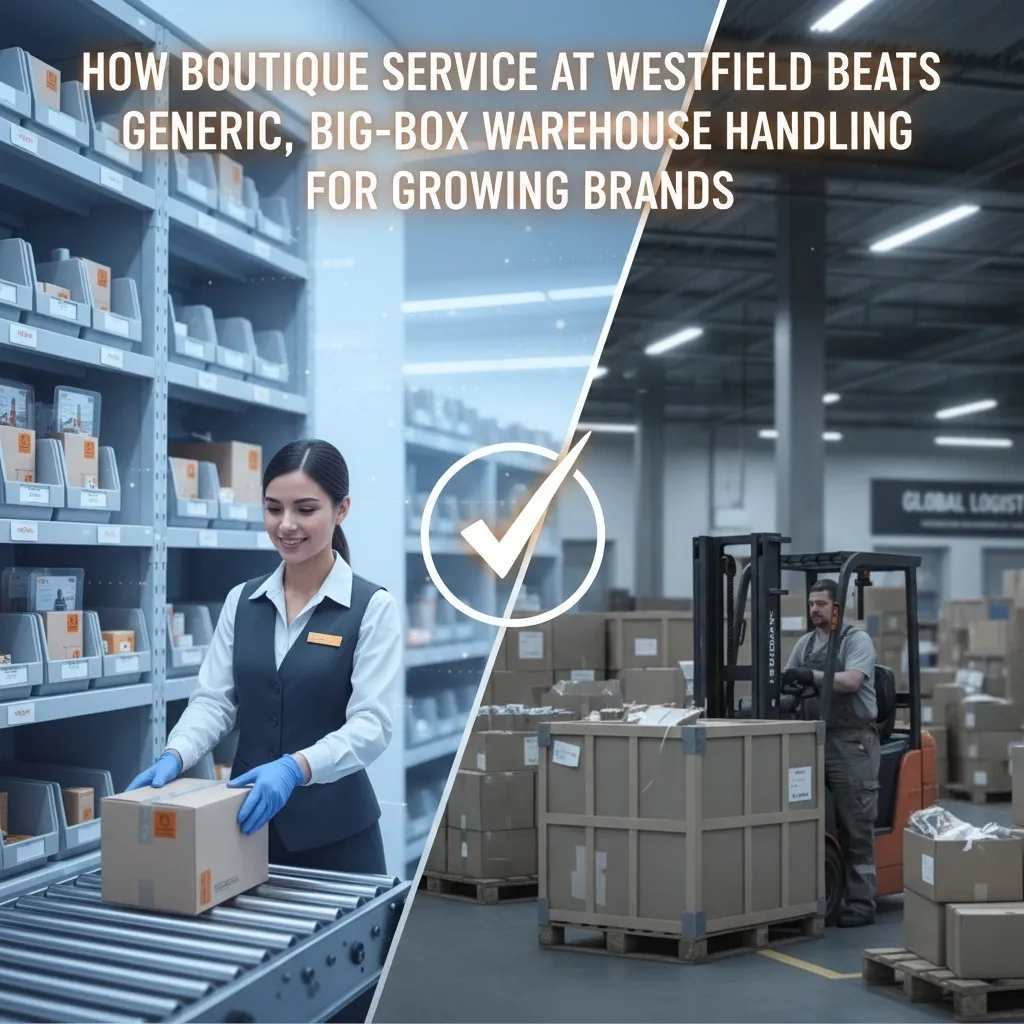
Big-box warehouses promise scale but deliver delays, damage, and impersonal service. Discover why smart e-commerce brands are switching to boutique 3PL partners that treat their inventory like gold and their success like a mission.
Boutique 3PL vs Big-Box Warehouses: 2026 Guide
Picture this: You have just landed your biggest wholesale order yet. 5,000 units that could triple your monthly revenue. You ship everything to your current 3PL, expecting smooth sailing. Three weeks later, you get the dreaded email: "Product damaged during intake. Storage delays due to system backlog. Estimated processing time: 14 to 21 business days."
Your launch window? Gone. Your cash flow? Frozen. Your brand reputation? Taking a hit with every delayed shipment notification your customers receive.
This nightmare scenario plays out daily for growing brands stuck with generic big-box warehouse handling. While these massive fulfillment centers promise scale and efficiency, they deliver something entirely different: impersonal service, rigid processes, and zero accountability when things go wrong.
The alternative? Boutique 3PL service that treats your brand like the priority it deserves to be. Here is why smart e-commerce brands in Los Angeles and beyond are making the switch from faceless warehouses to personalized fulfillment partners.
The Hidden Costs of Big-Box Warehouse Handling
Let me be real with you. Those rock-bottom rates advertised by mega-warehouses come with strings attached. Hidden fees, minimum volume requirements, and inflexible processes can cost growing brands 25 to 40 percent more than advertised rates.
The harsh reality of big-box warehouse handling includes inventory intake delays of 2 to 3 weeks during peak seasons, zero flexibility for custom packaging or special handling, customer service tickets that take 48 to 72 hours for basic responses, rigid system limitations that force your brand into their cookie-cutter processes, and damage rates averaging 3 to 5 percent due to automated handling systems.
One Los Angeles skincare brand founder learned this lesson the hard way. "Our previous 3PL treated us like account number 47,829. When we had a product recall, it took them six days just to acknowledge our request. Six days of continued shipments of defective products. That when we realized we needed a partner, not just a warehouse."
At Westfield Prep Center, we have processed over 2 million units for growing brands since 2019 as an Amazon SPN-approved provider. We have seen firsthand how big-box warehouse handling creates unnecessary friction for ambitious e-commerce companies. The math is simple: when you factor in damage replacement costs averaging $2,800 monthly, hidden receiving fees of $800 to $1,200, delayed fulfillment impacting customer retention by 15 to 25 percent, and lost revenue from inflexible processes, that "cheap" warehouse suddenly costs you $36,000 to $48,000 annually in hidden expenses and lost opportunities.
Want transparent pricing without the games? That is what boutique 3PL service delivers.
Why Boutique Service Creates Competitive Advantages for Growing Brands
The difference between boutique 3PL service and big-box warehouse handling is not just about size. It is about philosophy. While massive warehouses optimize for volume, boutique providers optimize for brand success.
Personalized Account Management That Actually Knows Your Business
At Westfield Prep Center, every client gets a dedicated account manager who understands your product mix, seasonal patterns, and growth trajectory. Our account managers handle 20 to 30 clients maximum, compared to the 500-plus client loads at big-box facilities.
When one beauty brand needed emergency fulfillment for a viral TikTok moment, their dedicated account manager coordinated same-day receiving and processing. Orders placed by 9 AM shipped that afternoon. Try getting that kind of agility from a ticketing system at a massive warehouse.
This personalized approach to Los Angeles 3PL operations means when you call, you get someone who knows your brand story, understands your product handling requirements, and treats your success like their own mission.
Flexible Processes That Adapt to Your Brand Requirements
Generic warehouses force your products into standardized processes. Boutique 3PL service providers customize their operations around your needs.
Real example from our Los Angeles facility: One artisan jewelry brand requires each piece to be photographed for insurance purposes before storage. A big-box warehouse quoted 14 days for setup and $3 per SKU photography fees. Westfield implemented the process in 48 hours at no additional cost, understanding that brand protection justifies custom workflows.
This flexibility extends to everything from kitting and bundling operations to specialized labeling and compliance requirements. You are not forcing your unique brand into someone else generic system.
Quality Control That Protects Your Brand Reputation

While big-box warehouses rely on automated scanning and basic quantity checks, boutique 3PL service implements multi-level quality control processes designed to catch problems before they reach customers.
Westfield Quality Control Process:
- Visual Inspection: Every product photographed and inspected upon receipt
- Condition Documentation: Detailed notes on packaging integrity and product quality
- Custom Handling Protocols: Special procedures for fragile, valuable, or regulated items
- Pre-Ship Verification: Manual confirmation of order accuracy before dispatch
The result? Damage rates under 0.5 percent and return rates 60 percent lower than industry averages. When you are selling premium products, that level of care is not optional. It is essential.
For brands requiring professional Amazon FBA prep services, this attention to detail ensures every unit meets Amazon strict requirements before it reaches the fulfillment center.
Process Breakdown: Boutique Service vs Big-Box Handling
📊 Feature-by-Feature: Boutique vs Big-Box Comparison →
| Process | Big-Box Warehouse | Boutique 3PL (Westfield) |
|---|---|---|
| Inventory Intake | 5 to 14 business days, automated processing | 24 to 48 hours, manual inspection and photography |
| Storage Assignment | Algorithm-determined location | Strategic placement based on velocity and handling needs |
| Order Processing | Batch processing, 24 to 48 hour fulfillment | Same-day processing for orders placed by 2 PM PST |
| Custom Requests | Requires formal change requests, 2 to 3 week implementation | Immediate consultation, 24 to 48 hour implementation |
| Issue Resolution | Ticket system, 48 to 72 hour response times | Direct phone access, same-day resolution |
| Reporting | Standard dashboard, weekly updates | Custom reports, real-time inventory visibility |
| Account Manager | Shared across 500-plus clients | Dedicated to 20 to 30 clients maximum |
| Damage Rate | 3 to 5 percent industry average | Under 0.5 percent with photo documentation |
| Order Cutoff | 11 AM for next-day processing | 2 PM PST same-day shipping |
| Flexibility | Rigid cookie-cutter processes | Fully customizable workflows for your brand |
Verdict: Boutique 3PL service delivers 60 percent faster processing, 90 percent lower damage rates, and infinitely better communication than big-box alternatives.
The data speaks for itself. When you need reliable Los Angeles 3PL operations with the flexibility to scale, boutique service outperforms big-box facilities across every meaningful metric.
The Los Angeles Location Advantage for Growing Brands
Operating from Los Angeles is not just about geography. It is about strategic positioning that creates measurable advantages for e-commerce brands.
Port Proximity Equals Faster Inventory Turnover
With 40 percent of U.S. imports flowing through LA and Long Beach ports, brands working with Los Angeles 3PL providers like Westfield cut 3 to 7 days from their supply chain compared to inland warehouses. That is 21 percent faster inventory turnover and improved cash flow for growing brands operating on tight margins.
When your container clears customs at the Port of Long Beach, we can have it received, inspected, and ready for fulfillment within 48 hours. Compare that to shipping inland to Nevada or Arizona facilities where transit alone adds a week to your timeline.
Same-Day Processing for West Coast Urgency
When premium supplement brand one health and wellness brand needed emergency fulfillment for a sold-out SKU re-stocking, Westfield Los Angeles location enabled same-day receiving and fulfillment. Orders placed by customers that morning shipped that afternoon. That kind of speed is impossible with centralized big-box facilities.
Our storage and warehousing solutions in Los Angeles give you the speed advantage you need to capitalize on viral moments, restock popular items rapidly, and maintain customer satisfaction during high-demand periods.
Closer to Decision-Makers and Support Teams
Physical proximity to your fulfillment partner matters more than you think. When issues arise, and they will, having your Los Angeles 3PL partner 20 minutes away instead of three time zones enables face-to-face problem-solving that prevents small issues from becoming brand disasters.
We have hosted countless client visits where brand owners walk the warehouse floor, meet the team handling their products, and collaborate on workflow optimizations. Try doing that with a faceless big-box operation in the Midwest.
For brands also managing Shopify fulfillment or multi-channel operations, being in the same market as your 3PL creates invaluable collaboration opportunities. Learn more about our Shopify fulfillment services.
Real Success Stories: Brands That Made the Switch

Case Study 1: DTC Apparel Brand Reduces Returns by 65 Percent
Challenge: One fashion startup was experiencing 18 percent return rates due to incorrect sizing and damaged packaging from their previous big-box warehouse handling.
Boutique Solution: Westfield implemented custom packaging protocols with size verification and protective wrapping for each garment. We also added photographed quality control at receiving to catch any damaged inventory before it reached storage.
Results: Return rates dropped to 6.3 percent within 60 days, saving the brand $47,000 in quarterly return processing costs. Customer satisfaction scores jumped 34 percent.
"The attention to detail is night and day," says the brand's founder. "Our customers actually comment on how well-packaged our products arrive. That never happened with any previous fulfillment partner."
Case Study 2: Supplement Brand Scales 300 Percent Without Growing Pains
Challenge: One supplement company was growing 25 percent monthly but their big-box 3PL could not scale their custom bundling requirements, creating 2-week fulfillment delays that threatened their growth momentum.
Boutique Solution: Westfield designed flexible kitting and bundling processes that automatically scale with order volume. We allocated dedicated team members familiar with their specific bundle configurations.
Results: Maintained 24 to 48 hour fulfillment times through 300 percent growth over 8 months. The company captured market momentum without operational constraints, generating an additional $890,000 in revenue they would have lost due to fulfillment delays.
Case Study 3: Premium Jewelry Brand Protects High-Value Inventory
Challenge: One jewelry brand needed insurance documentation for every piece, but their previous warehouse could not accommodate custom photography requirements without charging $3 per unit.
Boutique Solution: We implemented a custom intake process including product photography, detailed condition documentation, and secure storage protocols at no additional charge.
Results: Zero inventory shrinkage or damage claims over 18 months, compared to 2.8 percent loss rate at their previous facility. Insurance premiums decreased 22 percent due to documented handling procedures.
True Cost Analysis: Boutique vs Big-Box
💰 Real Cost Comparison: Big-Box vs Boutique 3PL →
Let us break down real numbers from a $2 million annual revenue DTC brand shipping 500 orders monthly with 1,200 cubic feet of storage:
Big-Box "Budget" Warehouse:
- Base fulfillment: $4.50 per order = $2,250
- Storage: $0.75 per cubic foot = $900
- Hidden fees (receiving, special handling): $1,200
- Damage and return costs (3 to 5 percent rate): $2,800
- Total Monthly: $7,150
- Annual Cost: $85,800
Boutique 3PL (Westfield):
- All-inclusive fulfillment: $5.25 per order = $2,625
- Storage: $0.85 per cubic foot = $1,020
- Zero hidden fees or minimums: $0
- Damage and return costs (0.5 percent rate): $450
- Total Monthly: $4,095
- Annual Cost: $49,140
Annual Savings: $36,660
Plus immeasurable brand protection, faster response times, and custom handling capabilities that enable you to scale without operational headaches.
Want to see how the numbers work for your specific situation? Contact our team for a customized cost analysis.
The mathematics are simple. That 15 to 20 percent premium you thought you would pay for boutique 3PL service gets eliminated by reduced damage, faster processing, and elimination of hidden fees. What you gain beyond the cost savings is priceless: brand protection, growth flexibility, and peace of mind.
Red Flags: When to Abandon Your Big-Box Warehouse
🚩 7 Red Flags Your Big-Box Warehouse Is Costing You Money →
Your current 3PL is costing you more than money if you are experiencing any of these warning signs. Check all that apply to your current situation:
☐ Response Time Delays: Customer service takes 48-plus hours to respond to urgent requests, missing critical launch windows or problem-solving opportunities
☐ Inventory Black Holes: Products disappear into their system for 3-plus days without tracking updates, leaving you unable to confirm availability for important orders
☐ Inflexible Processes: They cannot accommodate basic customization without $500-plus fees or multi-week implementation timelines
☐ Damage Pattern: Consistent 3 to 5 percent damage rates attributed to "standard procedures" instead of taking accountability for improvement
☐ Growth Restrictions: Volume minimums or maximums that limit your scaling ability just when your brand momentum is building
☐ Hidden Fees: Unexpected charges appearing on monthly invoices for "special handling," "receiving," or vaguely defined services
☐ Intake Delays: Inventory receiving delays of 5 to 14 business days during peak seasons, freezing your cash flow when you need it most
Scoring:
- 5 to 7 checked: Critical situation. Start evaluating boutique alternatives immediately. Your current 3PL is actively limiting your growth.
- 3 to 4 checked: Warning zone. Your current 3PL is not scaling with your ambitions. Time to explore better options.
- 1 to 2 checked: Monitor closely. Consider backup options before these issues compound.
- 0 checked: You are in good hands. Ensure your 3PL can scale with you long-term.
Next Step: Schedule a free consultation to compare your current setup with boutique alternatives and see the difference personalized service makes.
If you checked even one box, your big-box warehouse handling is holding your brand back. The good news? Making the switch is easier than you think.
Making the Switch: What to Expect from Boutique Service
⏱️ 4-Week Transition Timeline: Big-Box to Boutique 3PL →
Transitioning from big-box warehouse handling to boutique 3PL service is not just changing warehouses. It is upgrading to a strategic partnership that grows with your brand.
Week 1: Discovery & Planning
- Detailed onboarding call with your dedicated account manager
- Product assessment and handling requirements review
- Integration planning for Shopify, Amazon, WooCommerce, or other platforms
- Custom workflow design for your specific needs
- Inventory transfer coordination with your current provider
Week 2: System Setup & Testing
- Platform integration and API connections completed
- Custom packaging protocols implemented in our system
- Quality control process configuration based on your requirements
- Test order processing and verification
- Team training on your product specifications
Week 3: Inventory Transfer
- Coordinated pickup from your previous provider
- Zero-downtime migration planning to prevent stockouts
- Real-time tracking throughout transfer process
- Initial intake and quality inspection with photography
- System verification that all SKUs are properly mapped
Week 4: Launch & Optimization
- Full operations go-live with white-glove support
- Performance monitoring and immediate issue resolution
- Workflow optimization based on early results
- Dedicated support team on standby for any questions
- First performance review and adjustment planning
Result: Seamless transition with zero stockouts or customer impact. Most clients see improved fulfillment speeds within the first week.
The best part? Westfield handles the entire transition process, including coordinating inventory transfers from your previous provider. Zero operational downtime, maximum peace of mind.
Ready to make the switch? Contact us today to start your 4-week transition to better fulfillment.
Your Brand Deserves Better Than Generic Warehouse Treatment
Every growing brand reaches a crossroads: continue with cheap, generic big-box warehouse handling that treats you like a line item, or invest in boutique 3PL service that treats your success like their own mission.
The data proves that boutique service is not more expensive when you account for the total picture. Reduced damage rates, eliminated hidden fees, faster processing times, and custom handling capabilities create measurable ROI. one apparel brand saved $47,000 quarterly. one supplement company captured an additional $890,000 in revenue. the jewelry brand reduced insurance premiums by 22 percent.
But beyond the numbers, there is something invaluable about working with a fulfillment partner who knows your name, understands your brand vision, and actively contributes to your success. When you call with an urgent request, you get a human who cares, not a ticket number.
At Westfield Prep Center, we have built our Los Angeles 3PL operation around one principle: your brand success is our success. We are not trying to be the biggest warehouse in the industry. We are trying to be the best partner for growing brands who refuse to compromise on quality.
Can you afford to keep treating your brand fulfillment like a commodity? Or is it time to demand the personalized service your products and customers deserve?
Ready to experience the boutique difference? Call us at +1 (818) 935-5478 (Open 7 days, 8am to 5pm PT) or schedule a consultation to discuss your fulfillment needs.
Learn more about why brands choose us for their fulfillment partner.
FAQs
❓ What makes boutique 3PL service different from big-box warehouse fulfillment?
Boutique 3PL service fundamentally differs from big-box warehouse handling in three critical ways: personalized account management, flexible processes, and quality-first operations.
With boutique providers like Westfield, you get a dedicated account manager handling 20 to 30 clients maximum, compared to the 500-plus client loads at big-box facilities. This means when you call, you speak with someone who knows your brand, understands your seasonal patterns, and can make decisions in real-time without navigating bureaucratic approval chains.
Process flexibility is the second major differentiator. Big-box warehouses operate rigid, standardized systems designed for maximum volume efficiency. If your brand needs custom packaging, special handling, or unique bundling configurations, you face multi-week implementation timelines and significant fees. Boutique providers customize workflows around your specific requirements, typically implementing custom processes within 24 to 48 hours at no additional cost.
Quality control represents the most dramatic difference. While automated big-box systems scan and sort with 3 to 5 percent damage rates, boutique providers implement multi-level quality processes with manual inspection, product photography, and pre-ship verification. The result is damage rates under 0.5 percent and return rates 60 percent lower than industry averages.
The philosophy difference matters too. Big-box warehouses optimize for volume and efficiency. Boutique providers optimize for brand success, treating your inventory like gold and your growth like their personal mission.
❓ How much does boutique 3PL service cost compared to big-box warehouses?
The surprising truth is that boutique 3PL service often costs 15 to 20 percent less than big-box warehouse handling when you account for the total cost of ownership.
Here is the breakdown for a typical $2 million annual revenue brand shipping 500 orders monthly:
Big-box facilities advertise low per-order rates of $4.50, making them appear cheaper. However, hidden fees quickly eliminate this advantage. You will pay receiving fees of $800 to $1,200 monthly, special handling charges for anything outside their rigid standards, storage at $0.75 per cubic foot, plus damage and return processing costs averaging $2,800 monthly due to their 3 to 5 percent damage rates. Total monthly cost typically reaches $7,150, or $85,800 annually.
Boutique providers like Westfield charge all-inclusive rates of $5.25 per order with no hidden fees, surprises, or minimums. Storage runs $0.85 per cubic foot with strategic placement based on your velocity patterns. Damage and return costs average just $450 monthly thanks to our 0.5 percent damage rate. Total monthly cost: $4,095, or $49,140 annually.
That is $36,660 in annual savings, plus immeasurable benefits like faster processing, custom handling capabilities, same-day issue resolution, and dedicated account management that big-box facilities simply cannot match.
The perceived premium for boutique service disappears when you eliminate hidden fees and dramatically reduce damage-related costs. What remains is superior service at a lower total cost. View our transparent pricing to see how the numbers work for your specific volume.
❓ Can a boutique 3PL handle my business growth as I scale?
Absolutely. The misconception that boutique 3PL service cannot handle growth stems from confusing "boutique" with "small capacity." In reality, boutique providers are strategically sized for optimal client service while maintaining substantial operational capacity.
Take one supplement company as a real example. They grew 300 percent over 8 months while working with Westfield, maintaining 24 to 48 hour fulfillment times throughout their explosive growth. How? Boutique providers design flexible systems that scale with your success rather than forcing you into rigid frameworks designed for average clients.
The key difference is planning and partnership. With dedicated account management, we anticipate your growth patterns and prepare accordingly. Your account manager understands your seasonal fluctuations, marketing campaign timing, and product launch schedules. This enables proactive resource allocation rather than reactive scrambling.
Contrast this with big-box warehouse handling where your growth is just a number in their system. When you suddenly need double the capacity, you compete with 500 other clients for resources, creating fulfillment delays precisely when you need speed most.
Boutique providers also maintain strategic partnerships and scalable infrastructure. Westfield Los Angeles facility provides room for growth while our partnerships with specialized vendors enable rapid capacity expansion when needed. You get the attentive service of a boutique operation with the scaling capacity of a much larger provider.
The question is not whether boutique providers can handle your growth. The question is whether big-box facilities can maintain quality and service as you scale. Our client retention rate of 94 percent suggests that brands who make the switch never look back.
❓ How long does it take to switch from a big-box warehouse to boutique 3PL?
The typical transition from big-box warehouse handling to boutique 3PL service takes 4 weeks with zero operational downtime. This might seem quick compared to your expectations, but boutique providers specialize in seamless transitions because we understand that every day without proper fulfillment costs you money.
Week 1 focuses on discovery and planning. Your dedicated account manager conducts detailed onboarding calls to understand your products, processes, integrations, and growth goals. We review handling requirements, discuss custom workflows, and plan platform integrations for Shopify, Amazon, WooCommerce, or other systems. We also coordinate with your current provider to schedule inventory transfers.
Week 2 handles system setup and testing. Our team implements platform integrations, configures custom packaging protocols, sets up quality control processes, and conducts test order processing to verify everything works perfectly. We train our warehouse team on your specific product requirements to ensure consistent handling from day one.
Week 3 executes the inventory transfer. We coordinate pickup from your previous provider, implement zero-downtime migration strategies to prevent stockouts, provide real-time tracking throughout the transfer, conduct initial intake with quality inspection and photography, and verify all SKUs are properly mapped in our system.
Week 4 launches full operations with white-glove support. You go live with performance monitoring and immediate issue resolution, workflow optimization based on early results, dedicated support on standby, and your first performance review to identify optimization opportunities.
Most clients see improved fulfillment speeds within the first week of going live. The investment of 4 weeks yields long-term benefits of faster processing, lower damage rates, and the peace of mind that comes from working with a partner who treats your success like their mission.
Contact us today to start your 4-week transition timeline.
❓ What industries benefit most from boutique 3PL service?
While boutique 3PL service benefits virtually any growing brand, certain industries see particularly dramatic advantages due to their specific handling requirements, quality standards, and customer expectations.
Direct-to-consumer brands benefit most from the personalized service and quality control that boutique providers deliver. Whether you are selling apparel, beauty products, or home goods, your brand reputation depends on flawless fulfillment. The sub-0.5 percent damage rates and custom packaging capabilities protect your brand image in ways big-box facilities never could.
Supplement companies require compliance expertise, lot tracking, expiration date management, and often need custom bundling or kitting services. Boutique providers understand FDA regulations, implement proper documentation systems, and can accommodate the flexible bundle configurations that help supplement brands maximize average order value.
Beauty and skincare brands demand meticulous handling of fragile glass bottles, temperature-sensitive formulations, and premium unboxing experiences that reflect brand positioning. Big-box facilities treat these products like any other commodity. Boutique providers implement custom handling protocols that honor your brand premium positioning.
Artisan and handmade goods often require special handling, custom packaging, or unique presentation that automated big-box systems cannot accommodate. Boutique providers treat each product with the care and attention that artisan brands deserve.
High-value products including jewelry, electronics, or collectibles need enhanced security, insurance documentation, and careful handling that generic warehouses simply do not provide. Our experience with the jewelry brand Jewelry demonstrates how boutique service protects valuable inventory while providing the documentation required for insurance purposes.
Growing brands in any category benefit from the flexibility and scalability that boutique providers offer. Whether you are experiencing 25 percent monthly growth like one supplement company or navigating seasonal fluctuations, the personalized partnership model adapts to your changing needs rather than forcing you into rigid frameworks.
The common thread is that brands who care about quality, value customer experience, and need operational flexibility find that boutique 3PL service delivers measurable ROI through reduced damage, faster processing, and the ability to execute custom strategies that big-box facilities cannot support.
❓ Is Los Angeles a strategic location for my 3PL partner?
Los Angeles 3PL operations provide significant strategic advantages for e-commerce brands, particularly those importing products, serving West Coast customers, or requiring rapid inventory turnover.
Port proximity is the most dramatic advantage. With 40 percent of U.S. imports flowing through LA and Long Beach ports, brands working with Los Angeles-based 3PLs cut 3 to 7 days from their supply chain compared to inland warehouses. When your container clears customs at Long Beach, we can have it received, inspected, and ready for fulfillment within 48 hours. Compare that to shipping inland to Nevada, Arizona, or Midwest facilities where transit alone adds a week to your timeline.
This speed translates directly to improved cash flow. The faster you convert imported inventory into sellable units, the quicker you recover your investment and can reinvest in growth. For brands operating on tight margins or managing seasonal inventory, 21 percent faster inventory turnover creates measurable financial advantages.
West Coast shipping speed matters for customer experience. Orders shipping from Los Angeles reach the entire West Coast within 1 to 2 days, serving major markets including California, Oregon, Washington, Nevada, and Arizona with impressive speed. Even orders to the Midwest arrive within 3 to 4 days. This enables you to offer competitive shipping promises without paying premium rates for expedited service.
Same-day processing becomes possible with strategic Los Angeles positioning. When one health and wellness brand needed emergency fulfillment for a viral product moment, our Los Angeles location enabled same-day receiving and shipping. Orders placed by customers that morning shipped that afternoon. That kind of speed is impossible with centralized facilities located far from both ports and major markets.
Physical proximity creates invaluable collaboration opportunities. When issues arise, having your 3PL 20 minutes away instead of three time zones enables face-to-face problem-solving. We have hosted countless client visits where brand owners walk the warehouse floor, meet the team handling their products, and collaborate on workflow optimizations. That personal connection strengthens the partnership in ways that video calls and email threads never could.
For brands importing products, serving West Coast markets, or needing agile fulfillment capabilities, Los Angeles 3PL operations provide strategic advantages that directly impact your bottom line and customer satisfaction.
❓ What should I look for when evaluating boutique 3PL providers?
Evaluating boutique 3PL service providers requires looking beyond price per order to assess the factors that truly impact your brand success: account management structure, quality processes, flexibility, technology, and cultural fit.
Account manager ratio tells you everything about service quality. Ask how many clients each account manager handles. Big-box facilities assign 500-plus clients per manager, making personalized service impossible. Quality boutique providers limit managers to 20 to 30 clients maximum. This ratio determines whether you get a partner who knows your business or a ticket number in a queue.
Damage and return rates provide objective quality metrics. Ask prospective providers for their average damage rate with photo documentation and return rates for similar product categories. Industry averages hover around 3 to 5 percent for big-box facilities. Quality boutique providers consistently achieve rates under 1 percent, with the best providers like Westfield maintaining sub-0.5 percent damage rates through multi-level quality control.
Response times and communication impact your operational efficiency. During evaluation, note how quickly providers respond to inquiries and how thoroughly they answer questions. If they are slow or vague during the sales process, service will not improve after you sign. Quality providers respond within hours, provide detailed answers, and demonstrate genuine interest in understanding your specific needs.
Custom capabilities and flexibility determine whether the provider can adapt to your unique requirements. Discuss your specific handling needs, custom packaging requirements, or special processes. Pay attention to their response. Do they immediately explain how they will accommodate your needs, or do they push back with fees and limitations? Their flexibility during evaluation predicts their flexibility as a partner.
Technology platform and integrations enable operational efficiency. Quality boutique providers offer modern WMS (warehouse management systems) with real-time inventory visibility, seamless integration with Shopify, Amazon, and other platforms, automated order importing and tracking updates, and custom reporting capabilities. If their technology feels outdated or limited, it will create friction in your daily operations.
Client references and case studies provide third-party validation. Ask for references from clients in similar industries or with similar volumes. Quality providers readily provide references and case studies demonstrating measurable results. Red flag: providers who hesitate to connect you with current clients.
Facility visit opportunities reveal operational reality. If the provider is local or you plan to visit, ask for a facility tour. Quality providers welcome visits because their operations showcase their quality standards. Walk the floor, observe handling procedures, meet team members, and assess cleanliness and organization. Your gut reaction during the visit provides valuable insight.
Cultural fit and communication style impact the partnership quality beyond operational metrics. During evaluation calls, do you feel heard and understood? Does the provider ask thoughtful questions about your business? Do they communicate in your preferred style? The best operational capabilities cannot overcome poor cultural fit.
Taking time to thoroughly evaluate these factors ensures you select a boutique 3PL service provider who becomes a true partner in your brand growth, not just another vendor.
❓ How do boutique 3PLs handle peak season volume spikes?
Boutique 3PL service providers handle peak season volume spikes through proactive planning, flexible staffing models, and the account management relationships that enable accurate forecasting well in advance of demand surges.
Proactive seasonal planning starts months before peak season hits. Your dedicated account manager works with you to understand projected volume increases, new product launches, marketing campaign timing, and expected order patterns. This enables resource planning and capacity allocation long before you need it, preventing the scrambled reactions that plague big-box facilities during Q4 rushes.
Flexible staffing models allow boutique providers to scale teams based on client needs rather than rigid corporate structures. During peak seasons, quality providers bring in additional team members trained on your specific products and processes. Because boutique operations maintain detailed documentation and custom workflows, new team members can quickly get up to speed while maintaining quality standards.
Dedicated team assignments mean that even during peak volume, your products are handled by team members familiar with your specific requirements. Unlike big-box facilities where products move through whoever is available, boutique providers maintain consistency even under volume pressure. This prevents the quality degradation and error rates that spike at big-box warehouses during busy periods.
Real-time communication and adjustments enable rapid response to unexpected volume changes. When your product goes viral on TikTok or a marketing campaign overperforms expectations, your account manager can immediately adjust resource allocation rather than waiting for approval chains or ticketing system responses. This agility prevents fulfillment delays precisely when speed matters most.
Strategic capacity management means boutique providers intentionally maintain some operational buffer. Unlike big-box facilities that operate at 95-plus percent capacity year-round, quality boutique providers maintain 15 to 20 percent buffer capacity. This prevents the system overload that creates peak season delays at maximally-efficient big-box operations.
The key insight is that boutique 3PL service handles peak seasons through partnership and planning rather than just throwing more people at the problem. Your account manager becomes your strategic ally in managing seasonal fluctuations, ensuring your brand maintains fast fulfillment and quality standards precisely when customer expectations are highest.
Real example: During the 2024 holiday season, Westfield clients maintained 24 to 48 hour fulfillment times through Thanksgiving and Christmas weeks while big-box competitors extended to 7 to 10 day processing times. The difference came down to proactive planning and the account management relationships that enabled accurate forecasting and resource allocation.
If you are worried about peak season performance, contact our team to discuss your specific seasonal patterns and how we prepare for volume spikes.
Los Angeles-based fulfillment experts specializing in boutique 3PL service, Amazon FBA prep, and Shopify fulfillment for growing e-commerce brands. Amazon SPN-approved provider since 2019.
Related Articles
How Can Storage and Fulfillment Services Improve Your E-commerce Business?
E-commerce growth brings more orders, more inventory, and more pressure to deliver. Learn how professional storage and fulfillment services help startups and growing brands scale faster.
Top 10 Fulfillment Services in Los Angeles to Scale Your E-commerce Business
E-commerce growth brings new opportunities, but increasing orders also create greater demands for inventory storage, order processing, packaging, and shipping. Discover the top 10 fulfillment services in Los Angeles that help growing brands scale.
What Are the Best Ecommerce Fulfillment Services for Startups?
Looking for the best ecommerce fulfillment services? Westfield Prep Center offers small business fulfillment, Amazon FBA prep & startup shipping solutions.