
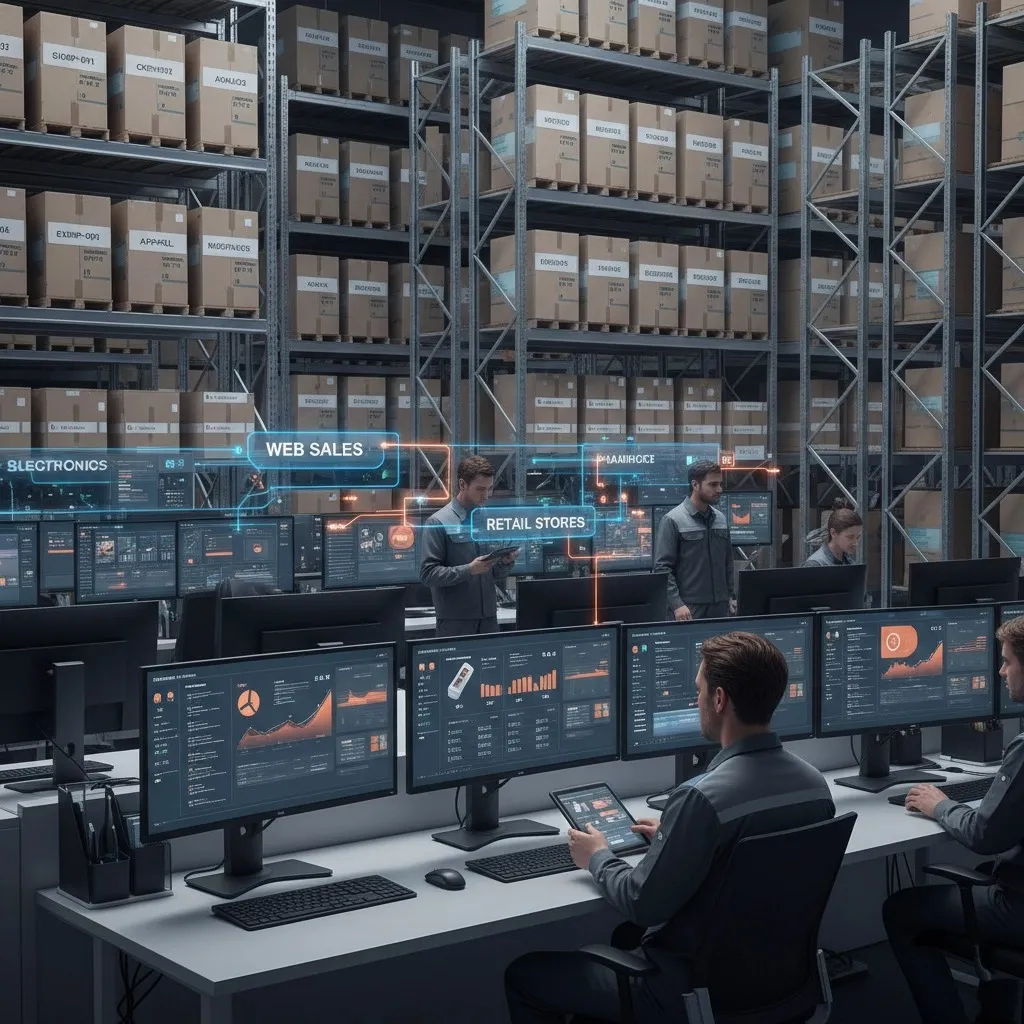
Your multi-channel inventory system is broken. You're losing $60,000+ annually to overselling, phantom stock, and emergency air freight. Here's the brutal math behind the chaos—and the 3-step recovery framework that actually works.
What is Multi-Channel Inventory Management?
Multi-channel inventory management is the process of tracking, synchronizing, and allocating product stock across multiple sales platforms simultaneously: typically Amazon, Shopify, TikTok Shop, Walmart Marketplace, and proprietary e-commerce stores. The goal: maintain accurate, real-time inventory counts to prevent overselling, eliminate stockouts, and optimize fulfillment across all channels.
Unlike traditional single-channel inventory systems, multi-channel inventory management requires:
- Real-time synchronization between platforms (not batch updates)
- Unified inventory pools rather than channel-specific allocations
- Cross-platform forecasting to predict demand patterns
- Automated reorder triggers based on multi-channel velocity
For growing e-commerce brands operating on 3+ sales channels with 100+ SKUs, professional multi-channel inventory systems become mandatory, not optional. Manual management beyond this scale results in 15-25% inventory discrepancies and chronic overselling incidents.
You're staring at your laptop at 2:47 AM.
Amazon just suspended your listing because you oversold by 43 units. Again.
Your Shopify store shows 87 units available. Your warehouse says 52. Your TikTok Shop backend claims 103. Your actual physical count? Nobody knows anymore.
You've got $127,000 worth of inventory spread across three warehouses, but you can't confidently tell a customer whether their order will ship tomorrow.
This isn't an inventory problem. This is a multi-channel inventory management failure. And it's costing you $60,000+ per year in ways you haven't even calculated yet.
Sound familiar? If you're an Amazon FBA seller, Shopify merchant, or TikTok Shop brand doing $100k+ monthly across multiple channels and losing 5%+ to inventory chaos, let's talk about stopping the bleeding before it gets worse.
💰 The Real Cost of Multi-Channel Inventory Management Failures
Let's do the math nobody wants to acknowledge.
U.S. retailers lose $1.75 trillion annually to inventory management failures, according to the Inventory Management Research Report 2024. That's not a typo. Trillion with a T.
For a brand doing $1.2M annually across Amazon, Shopify, and TikTok Shop? Your share of that disaster is roughly $60,000-$84,000 in completely preventable losses.
Here's where it's going:
Emergency Air Freight Because You Thought You Had Stock
$18,000-$24,000 annually
You listed a product on all three channels. Customer ordered on Amazon. Shopify hadn't synced yet. Another customer bought the same unit. Now you're paying 4X normal shipping costs to make the delivery promise because the alternative is account suspension.
Real scenario from a client: $847 to air freight 200 units from LA to Atlanta because their big-box warehouse's "batch sync" ran every 6 hours and missed a flash sale spike.
Platform Fees from Account Health Violations
$12,000-$18,000 annually
Amazon doesn't care that your warehouse uses batch updates. Oversell three times in a month? Your account health score drops. Performance penalties kick in. Now you're in restricted mode for 90 days, missing Q4.
The penalty isn't just fees. It's lost Buy Box eligibility, reduced organic ranking, and customer trust you can't buy back.
Carrying Costs on "Safety Stock" That's Actually Panic Inventory
$15,000-$22,000 annually
When you can't trust your inventory counts, you overcompensate. That $90,000 in inventory you're holding? Half of it is buffer stock covering for sync delays and inaccuracy.
Average inventory accuracy is only 65%. You're financing someone else's mistakes with your working capital at 12-18% annual cost.
Lost Sales from Phantom Stockouts
$15,000-$20,000 annually
Your system says "out of stock" but there are 47 units sitting in receiving. Or worse, your competitor captures the sale while you're stuck in manual reconciliation mode.
Research shows that 54% of sellers lack forecasting software, leading to chronic stockouts during peak demand periods.
Total annual cost: $60,000-$84,000
And that's before calculating the time you're personally spending:
- 15+ hours weekly reconciling inventory across platforms
- Another 8+ hours managing "where's my order?" customer service fires
- Emergency calls to freight brokers at premium rates
🚨 Why Multi-Channel Inventory Sync Breaks Everything (And Costs You $60K+)
Multi-channel inventory isn't complex because you're bad at business. It's complex because you're operating five separate systems that were never designed to talk to each other in real time.
The Inventory Accuracy Formula Multi-Channel Sellers Need to Know
Most brands track gross inventory (what you ordered). Smart brands track available inventory (what you can actually sell).
Available Inventory = On-Hand Units - Reserved Units - Damaged Units - In-Transit Units
But multi-channel brands need the effective available inventory formula:
Effective Available = (Available Inventory - Safety Stock Buffer) / Number of Active Channels
Example: You have 100 units available. Your safety stock minimum is 20 units. You sell on 4 channels (Amazon, Shopify, TikTok, Walmart).
Effective Available per Channel = (100 - 20) / 4 = 20 units max per channel
Without this calculation, you're risking overselling every single day.
The Four Horsemen of Multi-Channel Inventory Apocalypse
1️⃣ Platform Sync Delays (The 15-Minute Window of Chaos)
Amazon sells a unit at 2:00 PM. Your inventory management system updates at 2:15 PM. Your Shopify store doesn't get the update until 2:30 PM.
That 30-minute window? That's when the overselling happens.
You just sold the same physical unit twice. One customer is getting an apology email. The other is getting your last unit. Both are annoyed. Your margins just took a hit for the emergency fulfillment.
Why it happens: Most big-box warehouses use batch synchronization (updating counts 2-4 times daily) rather than real-time API pushes. They're optimized for volume efficiency, not multi-channel accuracy.
2️⃣ "Phantom Stock" in System Limbo
Your physical count: 143 units
Your warehouse system: 127 units
Amazon: 98 units
Shopify: 156 units
TikTok Shop: 84 units
One of these numbers is correct. You don't know which one. Your team spends 6 hours weekly doing manual counts and reconciliation. You're still not sure.
Why it happens: Each platform counts inventory differently. Amazon reserves units when orders are placed. Shopify reserves on payment authorization. TikTok Shop does whatever TikTok Shop feels like doing that day. Your warehouse uses a completely different system.
Nobody talks to each other in real time. Welcome to phantom stock hell.
3️⃣ The "Available vs. Allocated" Death Spiral
You have 200 units physically in your warehouse. Sounds great, right?
Actual breakdown:
- 50 units: In receiving (not processed yet)
- 30 units: Reserved for existing Amazon FBA shipment
- 20 units: Quarantined for quality check
- 15 units: Damaged (marked for return to supplier)
- 85 units: Actually available for sale
But your platforms don't know that breakdown. They just see "200 units" and let customers buy them.
Three customers just bought from your "available" stock that doesn't exist yet.
Why it happens: Your warehouse uses location-based inventory (receiving, available, damaged, hold). Your sales platforms use simple "in stock" vs "out of stock" logic. The translation layer between these systems? It's either non-existent or runs on a 6-hour delay.
4️⃣ The Forecasting Black Hole
You can't forecast what you can't accurately count.
When your inventory data is 65% accurate on a good day, every forecast becomes a dart throw. You're either:
- Overstocked by 90 days (killing cash flow and storage costs)
- Understocked by 14 days (triggering emergency air freight panic)
There's no middle ground when your baseline data is garbage.
Why it happens: Effective forecasting requires clean historical data across all channels. When your Amazon sales don't reconcile with Shopify returns and TikTok Shop "cancelled but actually shipped" orders, your forecasting software gives up.
Even if you had perfect software, you're feeding it contaminated data. Garbage in, garbage out.
📊 Big-Box Warehouses vs. Los Angeles Boutique 3PL: The Real Difference
| Factor | Big-Box Warehouse (Midwest) | Los Angeles Boutique 3PL |
|---|---|---|
| Inventory Sync Frequency | Batch updates (1x-2x daily) | Real-time (under 3 seconds) |
| Multi-Channel Integration | Siloed systems, manual reconciliation | Unified dashboard, automatic sync |
| Account Management | Generic rep handling 500+ accounts | Dedicated manager, direct communication |
| Port Proximity | 5-7 days rail transport from LA/Long Beach | Same-day receiving from Port of LA |
| Response Time to Issues | 24-72 hours via ticket system | Same-day resolution, direct contact |
| Pricing Model | Volume-based, hidden fees | Transparent per-unit pricing |
| Forecasting Tools | Basic reporting, no predictive analytics | AI-powered cross-channel forecasting |
| Emergency Fulfillment | Not available or 3X premium rates | Flexible rush options built-in |
| FBA Prep Services | Outsourced or not offered | In-house Amazon FBA prep |
| Ideal For | Established brands, single-channel focus | Growing multi-channel brands (3+ platforms) |
Key Takeaway: Big-box warehouses optimize for volume and cost. Los Angeles boutique 3PLs optimize for accuracy, speed, and multi-channel complexity, exactly what growing brands need to scale without chaos.
Ready to stop accepting "batch updates" and 72-hour sync delays as normal? Discover how Los Angeles 3PL services eliminate multi-channel headaches.
💸 How Big-Box Warehouses Multiply Multi-Channel Inventory Problems
Let's be clear: Big-box warehouses aren't designed for multi-channel complexity. They're optimized for single-SKU, high-volume clients where 15-minute sync delays don't matter.
For you? That 15-minute delay is costing you $5,000 monthly.
The Big-Box Reality
Account Manager Ratio: 1 rep per 400-600 accounts
Your "dedicated" account manager is juggling 473 other clients. When you email about an inventory discrepancy, you're in a ticket queue behind 127 other requests.
Response time: 48-72 hours. By then, you've already oversold another 23 units.
Batch Sync Windows: 2-4 updates daily
Their system updates inventory at:
- 6:00 AM
- 12:00 PM
- 6:00 PM
- 12:00 AM
Between those windows? You're operating blind. Your flash sale at 2:00 PM? They won't know about it until 6:00 PM. Four hours of overselling chaos.
"Unified Dashboard" That's Actually Five Separate Logins
They advertise "multi-channel integration." Reality: You're logging into five different systems, exporting five CSV files, and doing manual reconciliation in Excel.
This isn't inventory management. It's data archaeology.
💰 The Hidden Costs of Poor Inventory Management Across Sales Channels
💸 Storage Fees on Inventory You Don't Need
Annual cost: $8,000-$12,000
When you can't trust your counts, you hold 90-120 days of buffer stock "just in case." For every $100k in inventory, you're paying $12-18k annually in carrying costs (capital cost + storage fees + insurance + obsolescence risk).
Half of that buffer stock? It's covering for sync failures, not actual demand volatility. You're financing someone else's operational incompetence.
⏱️ Your Time (The Hidden $50k/year Cost)
Your hourly value: $150-250/hour (if you're doing $1.2M annually)
Time spent weekly on inventory reconciliation: 15-20 hours
That's $3,000-$5,000 weekly ($156,000-$260,000 annually) of founder/operator time spent on manual inventory management instead of growth activities.
Even if you delegate it, you're paying someone $25-35/hour to do work that should be automated. That's $20,000-$28,000 annually for a task that shouldn't exist.
📉 Lost Customer Lifetime Value
Cost per lost customer: $400-$800
Every overselling incident creates a customer service fire:
- Apology email (annoyed customer)
- Refund processing (lost sale + transaction fees)
- Review damage (1-star "never received my order" reviews)
- Lost repeat purchase opportunity
Most brands calculate the immediate refund cost ($50-150). Nobody calculates the lost LTV of a customer who won't return because you couldn't fulfill a basic order.
At 15 overselling incidents monthly, you're burning $72,000-$144,000 in customer lifetime value annually.
🚀 Opportunity Cost of Slow Inventory Turns
Annual cost: $15,000-$25,000 in unrealized profit
When 30% of your inventory is "safety stock" covering sync failures, your inventory turn rate drops from 8x to 5x annually. That's three fewer cycles to generate profit from the same capital.
Lower turns = slower cash conversion = higher capital requirements = more expensive growth.
Your competitor with accurate inventory? They're turning 8-10x annually and reinvesting profits while you're stuck financing phantom stock.
Losing $3,000-$5,000 monthly to preventable inventory mistakes? See how professional 3PL pricing delivers net positive ROI from day one.
✅ Professional Multi-Channel Inventory Solutions: Real-Time Sync That Actually Works
Here's what functional multi-channel inventory management looks like:
How Unified Inventory Dashboards Eliminate Channel Silos
One dashboard. One accurate count. Updated in real-time across all platforms.
When a customer buys on Amazon at 2:37 PM:
- Inventory decrements at 2:37:03 PM (3-second delay)
- Shopify updates at 2:37:03 PM
- TikTok Shop updates at 2:37:03 PM
- Your wholesale platform updates at 2:37:03 PM
- Your internal dashboard reflects the change at 2:37:03 PM
No batch updates. No 15-minute windows of chaos. No phantom stock.
Real-Time Inventory Updates vs. Batch Synchronization
Batch sync (big-box warehouses):
- Updates 2-4x daily at scheduled intervals
- Creates 4-6 hour blind spots between syncs
- Overselling happens during delay windows
- Manual reconciliation required daily
Real-time sync (professional 3PL inventory management systems):
- API-driven updates in under 3 seconds
- Every transaction triggers immediate platform updates
- Zero blind spots, zero sync delays
- Overselling drops to near-zero
The Integration Stack That Prevents Multi-Channel Inventory Chaos
Platform APIs (Not Manual Imports):
- Direct API connections to Amazon Seller Central, Shopify, TikTok Shop, Walmart
- Bidirectional sync (sales out, updates in)
- Webhook triggers for instant updates
Unified Inventory Pool Management:
- Single source of truth for all inventory counts
- Automatic allocation logic across channels
- Reserved stock tracking (FBA shipments, holds, quarantine)
- Location-aware counts (receiving, available, damaged)
Predictive Forecasting Across All Channels:
- Cross-channel demand analysis
- Seasonality detection per platform
- Automated reorder point triggers
- Stockout prevention 14-30 days ahead
Dedicated Account Management:
- Direct communication (no ticket systems)
- Same-day issue resolution
- Weekly inventory optimization calls
- Proactive stockout alerts
Result: Inventory accuracy improves from 65% to 98%+ within 30 days. Overselling incidents drop 85-95%. Manual reconciliation time eliminated entirely.
Selling on Amazon + Shopify + TikTok Shop and struggling with inventory accuracy? Our LA-based prep center specializes in multi-channel synchronization that actually works.
🌴 Why Los Angeles Prep Centers Solve Multi-Channel Inventory Chaos
Geography isn't just logistics; it's competitive advantage. Here's why Los Angeles-based 3PL prep centers eliminate multi-channel inventory nightmares that Midwest warehouses can't touch:
Port of Los Angeles Proximity = Faster Replenishment
The Port of LA handles 40% of all U.S. container imports. When your inventory arrives from overseas, LA-based prep centers receive and process shipments 15-30 days faster than inland warehouses. That's 2-4 weeks of additional buffer against stockouts.
Real scenario: Your bestseller arrives at Port of LA on Monday. LA prep center receives containers Tuesday morning, processes inventory by Wednesday afternoon, and updates all channels by Thursday. Same shipment to Ohio? Add 5-7 days for rail transport, 2-3 days for receiving, and you're live the following week, if their batch system doesn't delay updates further.
Real-Time Market Intelligence from the E-Commerce Hub
Los Angeles is where TikTok trends break first, where Shopify brands test viral products, and where Amazon FBA strategies evolve fastest. Operating in this ecosystem means LA prep centers see demand patterns before they hit national markets.
When a product goes viral on TikTok Shop at 9 AM Pacific, LA-based operations can reposition inventory and adjust allocations by noon. Midwest warehouses? They'll update their batch file tomorrow.
West Coast Distribution Advantage
75 million customers accessible via 1-2 day ground shipping from LA. This isn't just faster delivery; it's cheaper fulfillment that improves margins while meeting customer expectations.
For brands selling on Shopify + Amazon + TikTok Shop, unified LA-based storage and warehousing means optimized fulfillment routing across all channels without premium shipping costs.
Multi-Channel Expertise at Scale
LA's density of multi-channel e-commerce brands means prep centers here operate proven systems, not experimental approaches. When you need Amazon FBA prep, Shopify direct fulfillment, and TikTok Shop logistics integrated seamlessly, LA operators have done it thousands of times.
Midwest big-box warehouses treat multi-channel like an add-on feature. LA boutique 3PLs treat it as core competency.
Our Los Angeles prep center has processed over 2 million units across Amazon FBA, Shopify, and TikTok Shop: eliminating inventory chaos for 100+ multi-channel brands.
Bottom line: Location determines whether you're reacting to inventory chaos or preventing it. LA-based operations move at the speed modern multi-channel e-commerce demands.
📋 Multi-Channel Inventory Management Readiness Checklist
Use this checklist to assess whether you need professional inventory management immediately:
Channel Operations
- Operating on 3+ sales channels (Amazon, Shopify, TikTok, Walmart, etc.)
- Managing 100+ SKUs across multiple platforms
- Processing 50+ orders daily across all channels combined
- Unable to view accurate inventory across all channels in one dashboard
Inventory Accuracy
- Experiencing 3+ overselling incidents per month
- Inventory counts vary 15%+ between platforms
- Manual daily updates required to keep platforms synchronized
- Holding 90+ days of inventory for any product due to poor forecasting
Time & Cost Impact
- Spending 10+ hours weekly on inventory reconciliation
- Emergency air freight costs exceeding $500/month
- Unable to confidently forecast 30 days ahead
- Fear running promotions due to inventory uncertainty
Customer Impact
- Declining repeat purchase rates
- Increasing "out of stock" complaints
- Amazon account health score declining due to cancellations
- Unable to maintain 2-day shipping commitments
Scoring:
- 0-3 checked: You're managing (for now) but watch for growth
- 4-7 checked: Professional management will deliver immediate ROI
- 8+ checked: You're losing $3,000-$5,000+ monthly: urgent action needed
Get Your Free Inventory Assessment →
📅 The 30-Day Path from Multi-Channel Chaos to Inventory Clarity
Here's exactly what happens when you transition to professional multi-channel inventory management with a Los Angeles 3PL:
Week 1: Audit & Reconciliation
Days 1-3: Complete Physical Inventory Count
- Count all physical units in current warehouse
- Identify discrepancies between actual counts and platform data
- Document SKUs with chronic overselling issues
- Establish baseline accuracy metrics
Days 4-7: Platform Data Reconciliation
- Sync actual counts across Amazon, Shopify, TikTok Shop, other channels
- Set temporary conservative buffer stock to prevent overselling during transition
- Export historical sales data from all platforms for forecasting
Week 2: Platform Integration Setup
Days 8-10: API Connections & Testing
- Connect all sales channels to unified inventory system
- Configure real-time sync (under 3-second updates)
- Test sync accuracy with controlled test transactions
- Set up automated low-stock alerts
Days 11-14: Multi-Channel Rules Configuration
- Establish channel-specific buffer stock minimums
- Configure allocation logic (unified pool vs. channel-specific)
- Set reorder point triggers based on cross-channel velocity
- Map FBA prep requirements and Shopify fulfillment rules
Week 3: Optimization & Training
Days 15-21: System Fine-Tuning
- Monitor sync performance across all platforms
- Adjust buffer stock levels based on early data
- Configure promotional inventory holds for planned sales
- Set up forecasting algorithms using historical data
- Integrate kitting and bundling services for multi-SKU products
Days 22-28: Team Training & Handoff
- Dashboard training for your team
- Establish communication protocols with account manager
- Document standard operating procedures
- Schedule weekly optimization reviews
Week 4: Live Operation & Performance Monitoring
Days 29-30+: Full Production Mode
- Monitor overselling incidents (should drop to near-zero)
- Track inventory accuracy improvements (target: 95%+)
- Measure time savings (expect 15+ hours weekly recovered)
- Calculate cost savings from eliminated emergency fulfillment
Most brands see:
- Overselling incidents drop 85-95% in first week
- Inventory accuracy improves to 95%+ by week 3
- Manual reconciliation time eliminated by week 4
- Positive ROI achieved within 30-60 days
Start Your 30-Day Transformation →
❓ Multi-Channel Inventory Management FAQ
❓ Why is my multi-channel inventory not syncing between Amazon and Shopify?
Multi-channel inventory sync fails when platforms don't communicate in real-time. Most issues stem from three causes: batch synchronization delays (warehouses updating counts 1-2x daily instead of instantly), siloed inventory pools (each platform tracking separate counts rather than unified stock), and missing API integrations (manual CSV imports instead of automated webhook triggers).
The solution: Real-time inventory synchronization via direct API connections that update all platforms in under 3 seconds when any sale occurs. Professional Los Angeles 3PL services eliminate sync failures by maintaining a single source of truth that pushes instant updates across Amazon Seller Central, Shopify Admin API, TikTok Shop, and other platforms simultaneously.
❓ What causes phantom stock in multi-channel selling?
Phantom stock occurs when your system shows inventory that doesn't physically exist or is unavailable for sale. Common causes: units stuck in receiving (counted as "available" before processing), reserved stock for pending shipments (FBA prep allocations not deducted), damaged goods not flagged in the system, and sync delays between warehouse counts and platform displays.
The fix requires location-aware inventory tracking that distinguishes between receiving, available, damaged, hold, and in-transit units: then only displays truly available stock to sales channels. Boutique 3PLs prevent phantom stock by updating location status immediately as units move through receiving, QC, and allocation workflows.
❓ How often should multi-channel inventory sync?
Real-time synchronization (under 3 seconds) is mandatory for brands selling on 3+ platforms with 100+ SKUs. Batch synchronization creates dangerous blind spots: if your system updates every 6 hours, you have four 6-hour windows daily where overselling occurs unchecked.
Industry best practice: API-driven push updates triggered by every transaction. When a customer buys on Amazon at 2:37 PM, all platforms (Shopify, TikTok Shop, Walmart, internal systems) must update by 2:37:03 PM. Anything slower creates compounding accuracy issues as order volume increases.
❓ What is real-time inventory synchronization and why do I need it?
Real-time inventory synchronization means every sale, return, adjustment, or receipt instantly updates inventory counts across all sales platforms: typically in under 3 seconds via API webhooks. Unlike batch updates (which sync 1-2x daily), real-time sync eliminates the delay windows where overselling occurs.
You need it when operating on 3+ channels because: 15-minute sync delays create overselling opportunities (Customer A buys on Amazon at 2:00 PM, Customer B buys same unit on Shopify at 2:10 PM before sync completes), batch updates don't account for simultaneous purchases across platforms, and manual reconciliation becomes impossible above 50 daily orders. Real-time sync is the only method that scales with multi-channel growth.
❓ What's the difference between batch updates and real-time sync?
Batch updates collect inventory changes throughout the day and sync platforms at scheduled intervals (typically 2-4x daily). Warehouse processes 100 orders between 9 AM-3 PM, then pushes one bulk update at 3 PM to all platforms.
Real-time sync updates platforms instantly after each transaction via API webhooks. Customer buys at 2:37:14 PM, all platforms update by 2:37:17 PM.
The critical difference: batch updates create 4-6 hour blind spots where platforms show inaccurate counts, enabling overselling. Real-time sync maintains continuous accuracy across all channels. For multi-channel brands, batch updates save warehouse costs but create customer service nightmares. Real-time sync costs slightly more but eliminates overselling entirely.
❓ How much does poor multi-channel inventory management cost?
For brands doing $1-2M annually across Amazon, Shopify, and TikTok Shop, poor inventory management costs $60,000-$84,000 yearly through: emergency air freight to cover overselling ($18-24k), platform fees from account health violations ($12-18k), excess carrying costs on panic buffer stock ($15-22k), and lost sales from phantom stockouts ($15-20k).
Hidden costs add another $50,000-$80,000 annually: founder/operator time on manual reconciliation (15-20 hours weekly at $150-250/hour), lost customer lifetime value from overselling incidents ($400-800 per customer x 15 incidents monthly), and opportunity cost of slow inventory turns (30% inventory locked as safety stock).
Total: $110,000-$164,000 annually for most growing multi-channel brands.
❓ What are the red flags I need to switch to a professional 3PL?
Immediate red flags requiring professional multi-channel inventory management: experiencing 3+ overselling incidents monthly (indicates sync failures), spending 10+ hours weekly on manual reconciliation (operational breakdown), inventory counts varying 15%+ between platforms (accuracy crisis), and holding 90+ days inventory for any SKU (forecasting failure).
Secondary indicators: emergency air freight costs exceeding $500/month, declining Amazon account health score due to cancellations, increasing customer complaints about "out of stock" after ordering, and fear of running promotions due to inventory uncertainty. If 4+ of these apply, you're losing $3,000-$5,000 monthly: professional management delivers immediate ROI.
❓ Can I manage multi-channel inventory with spreadsheets?
Spreadsheet inventory management works only at micro scale: 1-2 channels, under 50 SKUs, fewer than 20 daily orders. Beyond this threshold, manual systems break down because: inventory changes happen faster than human update speed (10+ transactions hourly = impossible to keep current), platforms don't automatically pull from spreadsheets (manual export/import = 6-12 hour delays minimum), and human error compounds exponentially with transaction volume (95% accuracy with 10 daily entries becomes 75% accuracy with 100 entries).
At 3+ channels with 100+ SKUs and 50+ daily orders, manual management guarantees 15-25% inventory discrepancy rates. You're not failing: the method doesn't scale. Professional inventory systems become mandatory, not optional.
❓ What is the best 3PL for multi-channel ecommerce brands?
The best 3PL for multi-channel brands specializes in real-time inventory synchronization across Amazon, Shopify, TikTok Shop, and other platforms: not just basic warehousing. Look for these mandatory features: unified inventory dashboard showing accurate counts across all channels (not siloed platform data), API integrations that sync in under 3 seconds (not batch updates), proven multi-channel expertise with 50+ active brands (not experimental approaches), and geographic advantages like Los Angeles location for port proximity and West Coast distribution.
Boutique 3PLs in LA typically outperform big-box Midwest warehouses for growing brands doing $50k-$500k monthly because they treat multi-channel complexity as core competency rather than add-on feature. Complete our 3PL services assessment to identify your specific needs.
❓ How do I stop overselling on Amazon and Shopify at the same time?
To stop overselling across Amazon and Shopify simultaneously, you need real-time inventory synchronization (not batch updates) that updates both platforms in under 3 seconds when any sale occurs on either channel. Most overselling happens during the 15-30 minute lag between platform syncs: a customer buys on Amazon at 2:15 PM but your Shopify store doesn't update until 2:30 PM, allowing another sale of the same last unit.
Professional 3PL inventory management systems eliminate this lag entirely using API integrations that push instant updates across all channels. For brands selling on 3+ platforms, unified inventory pools managed by LA-based prep centers prevent the channel-specific allocation traps that cause chronic overselling.
🚀 End Your Inventory Chaos : Work With a Los Angeles 3PL That Actually Syncs in Real Time
Stop accepting overselling incidents as "part of doing business."
Stop losing $60,000+ annually because your big-box warehouse treats you like account #4,872.
Stop reconciling phantom stock at 2 AM because your platforms don't sync.
Here's what happens when you partner with a Los Angeles boutique 3PL that specializes in multi-channel inventory management:
✅ Real-time sync in under 3 seconds across Amazon, Shopify, TikTok Shop, Walmart, and your own store
✅ Unified inventory dashboard showing one accurate count: not five conflicting numbers
✅ Predictive forecasting that prevents stockouts 14-30 days before they happen
✅ Port of LA proximity for 15-30 days faster replenishment cycles
✅ Dedicated account management with same-day response times (not ticket systems)
✅ Transparent per-unit pricing that delivers 2-3% net positive ROI
If you're an Amazon FBA seller, Shopify merchant, or TikTok Shop brand doing $50k+ monthly across multiple channels, you're exactly who we built our system for.
Schedule Your Free Multi-Channel Inventory Audit →
We'll identify exactly where you're losing money, how much overselling is costing you monthly, and show you the specific system that eliminates multi-channel chaos.
No generic warehouse pitch. No "we'll get back to you in 48 hours." Just real solutions for brands that need inventory accuracy yesterday.
Your competitors already made the switch. They're capturing the market share you're losing while you're stuck in spreadsheets.
The inventory chaos ends now. What you do next determines whether you scale or stall.
Related Resources:
- Amazon FBA Prep Services in Los Angeles : Professional prep center for multi-channel brands
- Shopify Fulfillment Services : Direct-to-consumer order processing with real-time sync
- 3PL Storage & Warehousing : Strategic LA location for faster replenishment
- Transparent 3PL Pricing : See exactly what professional inventory management costs
- Why Choose Our LA Prep Center : The boutique 3PL difference for growing brands
- Contact Us for Multi-Channel Inventory Audit : Free assessment of your current system
Expert team at Westfield Prep Center with years of experience in e-commerce fulfillment, multi-channel inventory management, and Los Angeles-based 3PL logistics.
Related Articles
How Can Storage and Fulfillment Services Improve Your E-commerce Business?
E-commerce growth brings more orders, more inventory, and more pressure to deliver. Learn how professional storage and fulfillment services help startups and growing brands scale faster.
Top 10 Fulfillment Services in Los Angeles to Scale Your E-commerce Business
E-commerce growth brings new opportunities, but increasing orders also create greater demands for inventory storage, order processing, packaging, and shipping. Discover the top 10 fulfillment services in Los Angeles that help growing brands scale.
What Are the Best Ecommerce Fulfillment Services for Startups?
Looking for the best ecommerce fulfillment services? Westfield Prep Center offers small business fulfillment, Amazon FBA prep & startup shipping solutions.