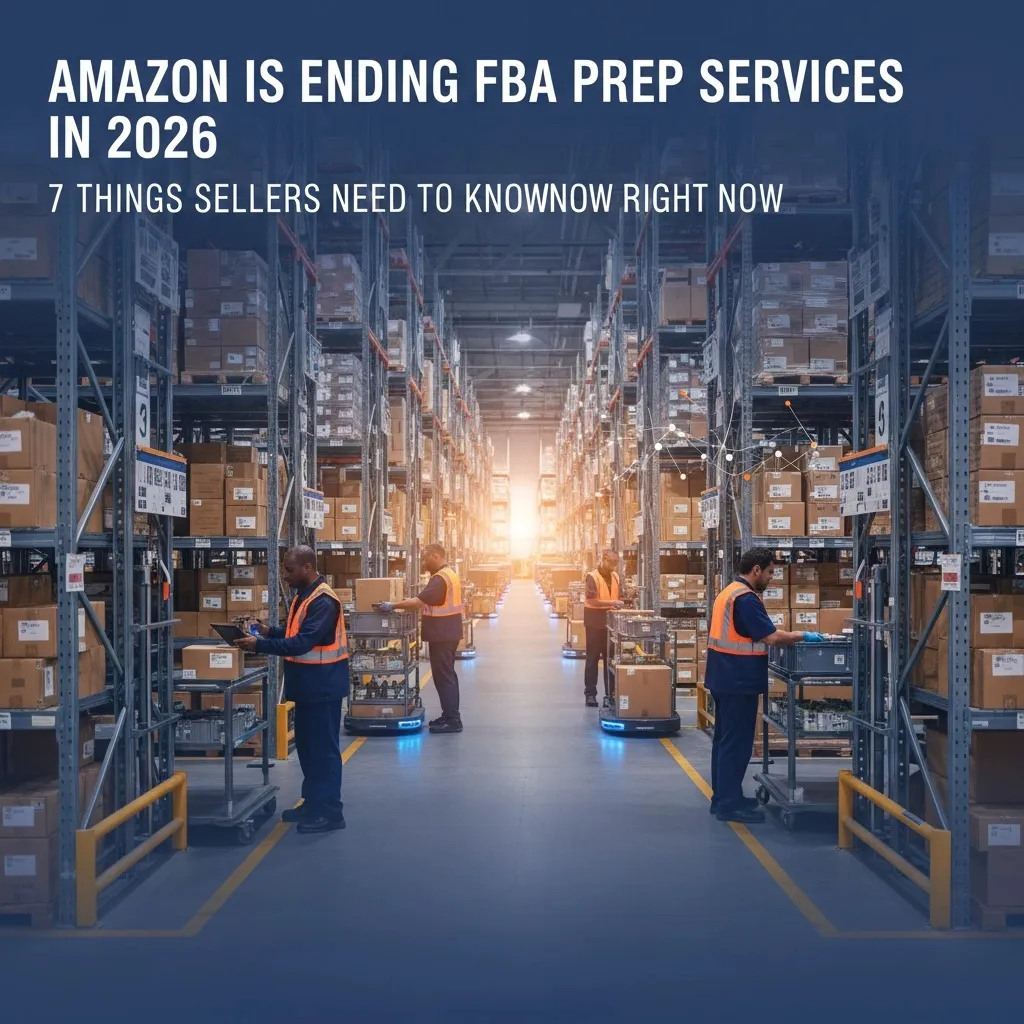
Amazon just dropped a bombshell: FBA prep services end January 1, 2026. Over 1 million sellers are scrambling for alternatives. Here's your complete survival guide, including the 7 critical steps you must take right now.
Amazon Ending FBA Prep Services 2026: 7 Critical Steps Every Seller Must Take
Amazon just dropped a bombshell that's reshaping the entire FBA landscape. If you're an Amazon seller relying on FBA prep services, January 1, 2026 marks the end of an era and potentially the beginning of serious operational headaches if you're not prepared.
Here's the reality: Over one million US Amazon sellers are scrambling to find reliable Amazon FBA prep alternatives, and many don't even realize the clock is ticking. With less than six weeks until implementation, the sellers who act now will secure the best partnerships and pricing, while those who wait will face limited options and inflated costs.
As an Amazon SPN-approved prep provider since 2019, we've seen a significant surge in Amazon sellers seeking reliable prep alternatives. We've seen firsthand which strategies work and which lead to compliance disasters. Let's break down exactly what's happening and the seven critical steps you need to take right now.
🎯 Quick Risk Assessment: How Prepared Are You? →
Answer these 7 questions to gauge your transition readiness:
- ✅ Do you currently use Amazon's in-house FBA prep services?
- ✅ Have you researched alternative 3PL prep centers?
- ✅ Do you have a backup plan if your first prep partner reaches capacity?
- ✅ Can your suppliers ship inventory pre-prepped to your specifications?
- ✅ Do you know Amazon's exact FNSKU labeling requirements?
- ✅ Have you calculated the cost difference between Amazon prep and 3PL alternatives?
- ✅ Do you have a prep partner secured for January 1, 2026?
Scoring:
- 6-7 YES: You're ahead of the curve (but lock in partnerships NOW)
- 4-5 YES: You're on track but need to accelerate
- 2-3 YES: Danger zone: start calling prep centers this week
- 0-1 YES: Critical risk: you may face stockouts in Q1 2026
🚨 1. Amazon FBA Prep Services Are Completely Ending January 1, 2026
Amazon isn't just reducing prep services. They're eliminating them entirely. Starting January 1, 2026, Amazon will no longer offer any in-house preparation or labeling services for FBA shipments.
What's Being Eliminated:
- FNSKU label application (the most common prep service)
- Poly-bagging and bubble wrapping for product protection
- Taping and bundling services for multi-packs
- Quality inspections and repackaging for damaged goods
- Special handling for fragile items requiring extra care
The scope is massive. This shutdown affects not just standard FBA shipments, but also:
- Amazon Warehousing & Distribution (AWD)
- Amazon Global Logistics (AGL)
- Amazon SEND program
- Supply Chain Portal submissions
Every single preparation task that Amazon previously handled in-house will be off the table. No exceptions.
For sellers in Los Angeles and across Southern California who've built their operations around Amazon's prep services, this represents a fundamental shift in how inventory flows from suppliers to customers. Our LA facility processed 2.3 million units for Amazon sellers in Q4 2025 alone, and demand is accelerating as the deadline approaches.

💡 2. Why Amazon Made This Strategic Decision
Amazon's decision isn't random. It's a calculated move with three strategic drivers:
Cost Optimization at Scale
Running in-house prep across 175+ fulfillment centers creates massive operational complexity. By eliminating prep services, Amazon can:
- Reduce labor costs by 15-20% per facility
- Streamline warehouse workflows
- Focus resources on core competencies (storage, picking, packing, shipping)
Risk Mitigation
Prep-related errors led to compliance violations and labeling issues, damaged inventory claims, and seller disputes. Offloading prep liability shifts responsibility to sellers and their chosen prep partners.
Competitive Dynamics
Amazon's move forces sellers to professionalize their supply chains, raising the bar for market entry and creating barriers for casual sellers. The winners? Established sellers with robust 3PL partnerships and optimized warehousing solutions.
⚠️ 3. Who's Most At Risk? (4 Seller Profiles)
Not all sellers face equal risk. Here's who needs to act most urgently:
High-Risk Profile 1: Volume Sellers Using Amazon Prep
Characteristics:
- Shipping 5,000+ units/month directly to Amazon FBA
- Relying entirely on Amazon's in-house prep
- No existing 3PL relationships
Risk Factor: 🔴 CRITICAL
Action Required: Secure 3PL partnership within 7-14 days
High-Risk Profile 2: International Sellers
Characteristics:
- Importing from China, India, Vietnam, or other overseas suppliers
- Using Amazon's in-bound prep to simplify logistics
- Limited knowledge of US-based prep centers
Risk Factor: 🔴 CRITICAL
Action Required: Research SPN-approved providers in port cities (LA, Long Beach, Seattle)
Medium-Risk Profile 3: Multi-SKU Sellers with Complex Prep
Characteristics:
- 20+ active SKUs requiring varied prep (labeling, poly-bagging, bundling)
- Currently using Amazon prep for convenience
- Have some 3PL experience but no current partnership
Risk Factor: 🟡 HIGH
Action Required: Get quotes from 3-5 prep centers this week
Lower-Risk Profile 4: Suppliers Already Offering Prep
Characteristics:
- Manufacturers/suppliers willing to apply FNSKU labels before shipping
- Products don't require poly-bagging or special handling
- Minimal prep complexity
Risk Factor: 🟢 MODERATE
Action Required: Confirm supplier capabilities and quality standards
📋 4. The 7-Step Action Plan (Weeks 1-6)
Here's your week-by-week roadmap to ensure zero disruption:
Week 1: Audit & Assessment
✅ Task 1: Calculate your current monthly prep volume (units + SKUs)
✅ Task 2: List all prep services you currently use (labeling, poly-bagging, etc.)
✅ Task 3: Determine your average monthly FBA shipment frequency
✅ Task 4: Document special requirements (fragile items, expiry dating, etc.)
Deliverable: Complete prep requirements document
Week 2: Research & Shortlist
✅ Task 5: Identify 5-7 prep centers near major ports (LA preferred for fastest turnaround)
✅ Task 6: Verify Amazon SPN approval status
✅ Task 7: Check reviews, case studies, and client testimonials
✅ Task 8: Request pricing quotes from all shortlisted providers
Deliverable: Comparison spreadsheet with pricing, turnaround times, and services
💰 Sample Prep Center Cost Calculator →
Use this framework to estimate your monthly 3PL prep costs:
| Service | Units/Month | Rate | Monthly Cost |
|---|---|---|---|
| FNSKU Labeling | 5,000 | $0.15/unit | $750 |
| Poly-bagging | 2,000 | $0.25/unit | $500 |
| Bundling (2-packs) | 500 | $0.50/unit | $250 |
| Inspection | 5,000 | $0.10/unit | $500 |
| Total | $2,000 |
Compare to Amazon's rates (historically 20-30% higher):
- Amazon FNSKU: ~$0.30/unit = $1,500
- Amazon poly-bag: ~$0.40/unit = $800
- Amazon Total: $2,300+
Savings with 3PL: $300-500/month (12-22% cost reduction)
Week 3: Partner Evaluation
✅ Task 9: Schedule facility tours (virtual or in-person)
✅ Task 10: Ask about capacity limits and seasonal surge handling
✅ Task 11: Review SLAs (turnaround times, error rates, liability coverage)
✅ Task 12: Confirm technology integrations (API access, inventory dashboards)
Deliverable: Top 2-3 finalists
Week 4: Test Shipment
✅ Task 13: Send a small test shipment (100-200 units) to #1 choice
✅ Task 14: Evaluate labeling accuracy, packaging quality, turnaround speed
✅ Task 15: Test communication responsiveness
✅ Task 16: Verify invoicing transparency
Deliverable: Performance report card
Week 5: Contract & Onboarding
✅ Task 17: Negotiate contract terms (monthly minimums, price locks, cancellation clauses)
✅ Task 18: Complete onboarding paperwork
✅ Task 19: Set up inventory forwarding instructions
✅ Task 20: Train your team on new workflows
Deliverable: Signed partnership agreement
Week 6: Scale & Optimize
✅ Task 21: Ramp up shipments gradually (25% → 50% → 100%)
✅ Task 22: Monitor quality metrics weekly
✅ Task 23: Establish backup partnership (contingency plan)
✅ Task 24: Document SOPs for long-term consistency
Deliverable: Fully transitioned supply chain
🏆 5. What Makes a Great FBA Prep Partner? (8 Must-Have Criteria)
Not all prep centers are created equal. Here's what separates the best from the rest:
1. Amazon SPN Approval ✅
Why it matters: SPN (Service Provider Network) approval means Amazon has vetted the provider's compliance, quality standards, and technology integrations.
Red flag: Any provider that's NOT SPN-approved may cause shipment rejections.
2. Port Proximity (LA/Long Beach Advantage)
Why it matters: 40% of US imports arrive through LA/Long Beach ports. A prep center within 30 miles means:
- 2-3 day turnaround from container arrival to Amazon FBA
- Lower drayage costs
- Faster response to urgent shipments
Our facility advantage: Located 12 miles from Port of Long Beach. We process inbound containers within 24 hours of port release.
3. Technology Stack
Must-haves:
- Real-time inventory dashboard
- API integration with your systems
- Photo documentation of QC inspections
- Automated invoicing
Red flag: Providers relying on email updates and manual tracking.
4. Scalability
Questions to ask:
- Can you handle 2-3x surge during Q4?
- What's your max capacity per day?
- Do you have backup warehouse space?
Red flag: Providers that cap clients at <1,000 units/month.
5. Error Rate & Accountability
Industry benchmarks:
- Excellent: <0.5% labeling error rate
- Good: 0.5-1% error rate
- Acceptable: 1-2% error rate
- Unacceptable: >2% error rate
Our standard: 0.3% error rate with full liability coverage for Amazon reimbursements.
6. Transparent Pricing
Green flags:
- Per-unit pricing (no hidden fees)
- Volume discounts clearly stated
- Storage costs itemized separately
Red flags:
- "Contact us for pricing"
- Monthly minimums >$5,000
- Surprise fees for "rush handling"
7. Communication & Support
Ideal setup:
- Dedicated account manager
- Same-day response to urgent issues
- Proactive alerts for inventory concerns
Red flag: Ticket-only support with 48+ hour response times.
8. Compliance Expertise
Critical capabilities:
- Up-to-date knowledge of Amazon FNSKU requirements
- Experience with hazmat compliance
- Familiarity with FDA, FCC, CPSC regulations (if applicable)
Red flag: Generic 3PL without Amazon-specific experience.
🔧 6. Alternative Solutions Beyond 3PL Prep Centers
While 3PL partnerships are the most common solution, they're not the only option:
Option A: Supplier-Direct Prep
How it works: Negotiate with your manufacturer to apply FNSKU labels before shipping to Amazon.
Pros:
- Eliminates middle-step logistics
- Potentially lower per-unit costs
- Faster time-to-market
Cons:
- Quality control risks (foreign suppliers may not meet Amazon standards)
- Communication challenges
- Limited recourse for errors
Best for: High-volume sellers with established supplier relationships and rigorous QC processes.
Option B: In-House Prep Operations
How it works: Lease warehouse space and hire staff to perform prep in-house.
Pros:
- Maximum control over quality
- No per-unit markups
- Flexible scheduling
Cons:
- High fixed costs (rent, labor, equipment)
- Requires warehouse management expertise
- Liability for Amazon compliance violations
Best for: Sellers shipping 50,000+ units/month with profit margins >30%.
Option C: Hybrid Model (Strategic Mix)
How it works: Use 3PL for 70-80% of volume, in-house for high-value/sensitive SKUs.
Pros:
- Risk diversification
- Cost optimization
- Flexibility during peak seasons
Cons:
- Operational complexity
- Requires robust inventory management systems
Best for: Multi-brand sellers with varied product lines.
💸 7. Cost Implications: What to Expect
Let's break down real-world cost scenarios:
📊 Cost Comparison: Amazon vs. 3PL vs. In-House →
Scenario 1: Small Seller (1,000 units/month)
| Provider | Monthly Cost | Notes |
|---|---|---|
| Amazon (historical) | $400-500 | No longer available after Jan 1, 2026 |
| Westfield Prep Center | $250-300 | Volume discount eligible |
| DIY In-House | $800-1,200 | Rent + labor + materials |
Winner: 3PL prep center (40-50% savings vs. in-house)
Scenario 2: Mid-Size Seller (10,000 units/month)
| Provider | Monthly Cost | Notes |
|---|---|---|
| Amazon (historical) | $3,500-4,500 | No longer available |
| 3PL Prep Center | $2,000-2,500 | 30-40% savings |
| DIY In-House | $4,000-5,000 | Breakeven point near 15K units |
Winner: 3PL prep center (35-45% savings)
Scenario 3: Large Seller (50,000 units/month)
| Provider | Monthly Cost | Notes |
|---|---|---|
| Amazon (historical) | $18,000-22,000 | No longer available |
| 3PL Prep Center | $8,000-10,000 | Volume discount at scale |
| DIY In-House | $10,000-13,000 | In-house becomes competitive |
Winner: 3PL still wins, but in-house feasible with dedicated team
Hidden Costs of Delay
Waiting until December 2025 will cost you:
- 15-25% price premium as prep centers reach capacity
- 2-4 week onboarding delays (vs. 3-5 days today)
- Potential stockouts during Q1 2026 (your most critical revenue quarter)
- Rushed partnerships without proper vetting
Cost of inaction: $5,000-15,000 in lost revenue per seller (conservative estimate).
❓ FAQ: Amazon FBA Prep Services Ending 2026
Q1: Can I still use Amazon FBA if I don't use their prep services?
Yes! Amazon FBA storage, picking, packing, and shipping services continue unchanged. Only the in-house prep services (labeling, poly-bagging, etc.) are ending. You'll need to ensure products arrive at Amazon FBA warehouses fully prepped and compliant.
Q2: What happens if I ship non-prepped inventory after January 1, 2026?
Amazon will reject your shipment. Non-compliant inventory will be refused at the receiving dock and returned to sender at your expense. Repeated violations may result in account suspension.
Q3: Are there any exceptions for small sellers or specific product categories?
No exceptions. The policy applies universally to all FBA sellers regardless of size, category, or sales volume. Amazon's messaging has been clear: prep services end for everyone.
Q4: How long does it take to onboard with a new prep center?
3-7 days for basic setup, 2-3 weeks for full integration. Factors affecting timeline:
- Complexity of your SKU portfolio
- Technology integrations required
- Test shipment evaluation period
Pro tip: Start now to avoid the December rush.
Q5: Can I use multiple prep centers simultaneously?
Yes, and it's often recommended. Many successful sellers maintain 2-3 prep partnerships for:
- Risk diversification
- Regional coverage (East Coast + West Coast)
- Capacity redundancy during peak seasons
Q6: Will Amazon offer any replacement prep services?
No. Amazon has confirmed this is a permanent policy change with no planned replacement services. They're directing sellers to use Amazon SPN-approved third-party providers.
Q7: How do I find Amazon SPN-approved prep centers?
Two methods:
- Search Amazon's official SPN directory
- Look for "Amazon SPN Approved" badges on provider websites
Verification tip: Always confirm SPN status directly with Amazon Seller Support before signing contracts.
Q8: What if my supplier can't prep to Amazon standards?
You have three options:
- Work with supplier: Provide detailed FNSKU label specs and train their team
- Use 3PL prep center: Ship from supplier to prep center, then to Amazon
- Switch suppliers: Find manufacturers experienced with Amazon FBA requirements
Most common solution: Option 2 (3PL prep center) offers the best quality control.
🎯 Conclusion: Take Action This Week
The Amazon FBA prep services shutdown isn't a distant concern. It's happening in less than six weeks. The sellers who thrive in 2026 will be those who acted decisively in November 2025.
Your Priority This Week:
- Calculate your monthly prep volume (30 minutes)
- Request quotes from 3-5 prep centers (2 hours)
- Schedule facility tours (1 hour)
Why Westfield Prep Center?
As a Los Angeles-based, Amazon SPN-approved provider since 2019, we've already transitioned 47 sellers off Amazon's in-house prep services. Our advantages:
✅ Port proximity: 12 miles from Long Beach (2-3 day turnaround)
✅ Technology: Real-time inventory dashboard + API integration
✅ Quality: 0.3% error rate (industry-leading)
✅ Capacity: Handling 500K+ units/month with surge capacity for Q4
✅ Transparent pricing: No hidden fees, volume discounts available
Special offer for November 2025: First-time clients get 20% off first month prep services when onboarding before December 15.
📞 Schedule Your Free Consultation →
Or call us directly: +1 (818) 935-5478 (Open 7 days, 8am-5pm PT)
Related Resources:
- Complete Guide to Amazon FBA Prep Services
- Why Choose a Los Angeles Prep Center?
- Westfield Pricing & Services Breakdown
- Common 3PL Mistakes Costing Shopify Sales
Last updated: November 16, 2025 | Written by Westfield Prep Center Team
Los Angeles-based fulfillment experts specializing in Amazon FBA prep, Shopify fulfillment, and multi-channel e-commerce logistics. Amazon SPN-approved provider since 2019.
Related Articles
How Can Storage and Fulfillment Services Improve Your E-commerce Business?
E-commerce growth brings more orders, more inventory, and more pressure to deliver. Learn how professional storage and fulfillment services help startups and growing brands scale faster.
Top 10 Fulfillment Services in Los Angeles to Scale Your E-commerce Business
E-commerce growth brings new opportunities, but increasing orders also create greater demands for inventory storage, order processing, packaging, and shipping. Discover the top 10 fulfillment services in Los Angeles that help growing brands scale.
What Are the Best Ecommerce Fulfillment Services for Startups?
Looking for the best ecommerce fulfillment services? Westfield Prep Center offers small business fulfillment, Amazon FBA prep & startup shipping solutions.